Prof. Hu is a distinguished translator, publisher, and senior French–Chinese translation specialist. He is a member of the China Writers Association, an expert member of the Translators Association of China, and a juror for the China selection of the Goncourt Prize. His translation of Gaston Gallimard: un demi-siècle d’édition française received the Fu Lei Translation and Publishing Prize in 2010. He was named Chevalier of the Order of Arts and Letters in 2002 and promoted to Officer in 2025.
Prof. Hu opened the lecture by outlining major developments in the history of Sino–French cultural exchange. Although not the earliest thread of East–West interaction, the relationship between China and France has been marked by long-standing continuity and significant cultural resonance. In the 17th- and 18th-centuries, Jesuit scholars such as Joachim Bouvet and Jean-François Gerbillon introduced Chinese classics, institutions, and scientific knowledge to Europe, sparking widespread interest. By the 19th and early 20th centuries, cultural engagement had become more reciprocal: Enlightenment ideas influenced China’s 1911 Revolution and the New Culture Movement, while Chinese artists studying in France contributed to the modernization of Chinese art. French artists, in turn, drew inspiration from Chinese calligraphy and ceramics.
From the mid-20th century onward, literature became one of the most vibrant arenas of exchange. French philosophical and literary works were translated into Chinese on an unprecedented scale, while French sinologists promoted the translation of modern Chinese authors such as Lao She. The first complete French edition of Dream of the Red Chamber was a landmark achievement. In the 21st century, bilateral cooperation expanded further through initiatives such as the China–France Cultural Year and the China–France Year of Culture and Tourism, accompanied by ongoing literary translation and deepening interest in each other’s cultural traditions—from martial arts and opera to wine, fashion, and New Wave cinema.

To illustrate these historical developments, Prof. Hu introduced four representative figures who significantly shaped Sino–French exchange: Huang Jialue, an early interpreter and pioneer of French sinology; Ding Dunling, who advanced the translation of Chinese poetry in France; Liang Zongdai, whose intellectual dialogue with Paul Valéry bridged two literary traditions; and Liao Xingqiao, who taught at Shenzhen University in the 1990s and played a key role in introducing French modernism to China.
Prof. Hu also highlighted Shenzhen’s contemporary role in cross-cultural engagement. As a city emblematic of reform and openness, Shenzhen has long served as a dynamic platform for international cultural exchange. Shenzhen Publishing House was among the first Chinese publishers to engage in copyright cooperation with French partners. Since 2000, it has hosted “French Book Day” during Shenzhen Reading Month and organized a range of important events, including Goncourt Prize centenary activities, collaborations with the “Croisements Festival,” and thematic literary seminars. The establishment of the “Sino–French Book-Talk Delegation” in 2017 further expanded Shenzhen’s presence in cultural institutions across both countries.

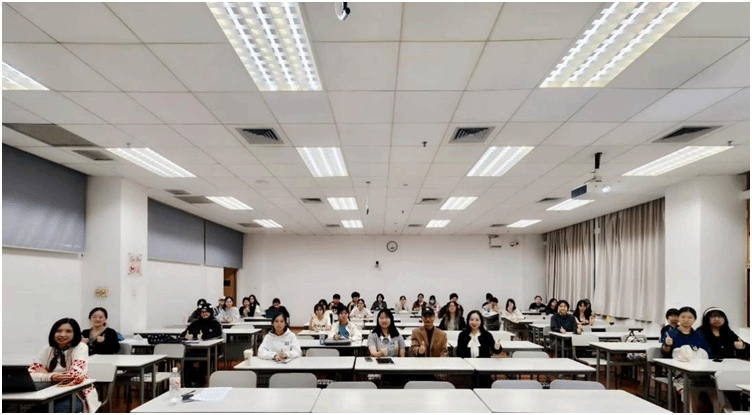
During the discussion session, students raised questions about promoting Chinese literature abroad, language-learning strategies, and the contribution younger generations can make to cultural exchange. Drawing on his extensive professional experience, Prof. Hu offered practical insights and encouraged students to engage in international communication with confidence, clarity, and cultural awareness.

In conclusion, Prof. Weng Bingying noted that the lecture provided a clear and compelling overview of Sino–French cultural exchange and demonstrated the influential roles played by individual scholars across different historical periods. She also highlighted Shenzhen’s growing significance as a cultural bridge. The lecture broadened perspectives and renewed interest in Sino–French research and dialogue.
Report by: Guo Jialiang
Photos: Chen Xinsi, Cui Qinyu, Guo Jialiang
Reviewed by: Prof. Weng Bingying


