Lecture Recap | Prof. Liu Xiaobin from South China Normal University Delivers Successful Lecture on "Foreign Language Teaching and Research Empowered by New Technologies and New Media"
Amid the wave of deep integration between educational digital transformation and intelligent technologies, foreign language disciplines are embracing new opportunities and challenges for teaching innovation and research breakthroughs. To help faculty and students of the College grasp the core logic of technology-empowered foreign language education and explore practical pathways for the deep integration of new technologies, new media with foreign language teaching and research, the College of Foreign Languages at Shenzhen University continues to host its series of lectures on "Technology-empowered Foreign Language Discipline Teaching and Research".
On the afternoon of April 10, 2026, the College specially invited Prof. Liu Xiaobin, Associate Dean and PhD Supervisor of the School of Foreign Languages and Cultures at South China Normal University, to deliver a keynote lecture entitled "Foreign Language Teaching and Research Empowered by New Technologies and New Media". The lecture was chaired by Associate Prof. Zhang Danyang, Associate Dean of the College of Foreign Languages at Shenzhen University. Faculty members and students of the College participated enthusiastically, creating a vibrant academic atmosphere.
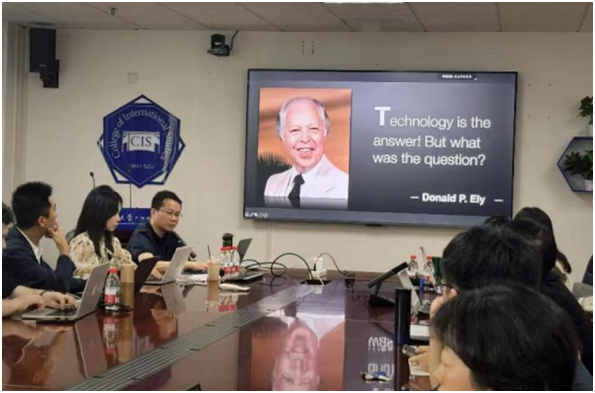
·Theoretical Foundation: Clarifying the Core Framework of Technology Empowerment
At the beginning of the lecture, Prof. Liu Xiaobin started with Donald P. Ely’s classic quote "Technology is the answer! But what was the question?" to highlight the essential nature of technology serving education, and guided the audience to reflect on the dialectical relationship between technology and foreign language teaching. He then systematically elaborated on the core framework of TPACK (Technological Pedagogical Content Knowledge), clearly breaking down the integration logic of Technological Knowledge (TK), Pedagogical Knowledge (PK), and Content Knowledge (CK). He emphasized that foreign language teachers need to build a comprehensive capability integrating "technology, pedagogy, and content", which is the fundamental prerequisite for effective technology empowerment in teaching. Meanwhile, combining the development of Computer-Assisted Language Learning (CALL), Prof. Liu reviewed the evolution from traditional multimedia teaching to intelligent technology empowerment, laying a solid theoretical foundation for the subsequent sharing of technology application scenarios.
·Multi-dimensional Empowerment: Deconstructing Applications of New Technologies in Teaching and Research
Centered on the core theme of "foreign language teaching empowered by new technologies and new media", Prof. Liu delivered an in-depth sharing from multiple dimensions, covering both teaching practice and academic research.
In terms of multimodality and the development of multiliteracies, Prof. Liu systematically introduced the core components of the multimodal semiotic system (linguistic, visual, auditory, gestural, and spatial). With teaching cases of multimodal writing for pre-service English teachers, he demonstrated how to optimize grammar teaching and enhance students’ language application abilities through multimodal resources such as videos and images, providing practical and innovative ideas for classroom instructional design.
In the field of Computer-Assisted Pronunciation Training (CAPT), Professor Liu analyzed research hotspots through keyword co-occurrence mapping in academic literature. By integrating speech visualization technology, he demonstrated how to achieve precise pronunciation assessment and personalized training through waveform comparison between standard pronunciation models and students' actual vocalizations, thereby providing a technical pathway for the digital transformation of speech education.
In addition, Prof. Liu elaborated on application scenarios of cutting-edge technologies including Data-Driven Learning (DDL), Mobile-Assisted Language Learning (MALL), VR/AR/metaverse, and systematically summarized research trends and practical values of each technological field. Regarding Artificial Intelligence Generated Content (AIGC), he outlined its application value in text creation, difficulty adjustment, content extraction, and lesson preparation, while stressing the ethical boundaries of technology application and the guiding role of teachers.
·Practical Guidance: Responding to Key Concerns in Frontline Teaching
At the end of the lecture, Prof. Liu Xiaobin focused on pain points in frontline teaching and responded to practical questions raised by faculty and students. In the Q&A session, when asked about "teaching challenges faced by student teachers and solutions", Prof. Liu pointed out based on K-12 foreign language teaching reality that most primary and secondary school students suffer from insufficient listening input, and Text-to-Speech (TTS) technology serves as an effective tool to tackle this problem. He emphasized that teachers should not rely solely on listening materials attached to textbooks, but actively use TTS technology to create personalized listening materials for students, enrich phonetic input scenarios, and effectively improve students’ listening and speaking abilities, providing precise methodological guidance for student teachers’ teaching practice. Meanwhile, Prof. Liu offered detailed and inspiring answers to questions concerning academic research topic selection and pedagogical design integrated with technology.
The most inspiring takeaway from the lecture was the core educational philosophy conveyed by Prof. Liu Xiaobin: the value of technology lies not in chasing trends, but in solving real teaching problems. He stressed that technology should not be adopted for its own sake; instead, it should be grounded in the needs of teachers and students, so that technologies and resources can truly take root in classrooms and serve people. Towards the end of the lecture, he encouraged the audience to reflect that learning should focus not only on outcomes but also on processes, deepening the participants’ understanding of the essence of education and the significance of technology empowerment.
Against the backdrop of educational digital transformation, technology-empowered foreign language education remains a long-term mission. Prof. Liu Xiaobin’s sharing pointed out the direction: staying true to the original aspiration of education, letting technology serve the essence of teaching, and returning resources to frontline needs. This lecture not only built a high-level academic exchange platform but also built consensus among faculty and students of the College: only by grounding in practice, focusing on processes, and meeting real needs can we achieve deep integration of technology with foreign language teaching and research. Guided by this philosophy, the College of Foreign Languages will continue to explore and innovate, build a new ecosystem of high-quality foreign language education, and support the cultivation of international, interdisciplinary, and innovative foreign language talents.
Written by Feng Gege
Reviewed by Zhang Danyang


