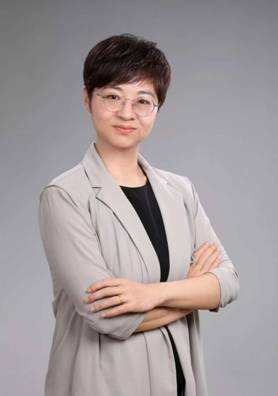
On the afternoon of May 19, 2025, the College of International Studies at Shenzhen University host a lecture titled “New Development, New Opportunities, and New Challenges in the International Communication of Chinese Culture.” The speaker was Ma Haolan, Director of the English Editorial Department at the Commercial Press and General Manager of the Commercial Press Wanbang Tonghe Company. The lecture was chaired by Zhou Mingying of the the College of International Studies.
About the Speaker:
Ma Haolan is Director of the English Editorial Department at the Commercial Press and General Manager of the Commercial Press Wanbang Tonghe Company. She also serves as a council member of the Translators Association of China, a supervisor of the Beijing Translators Association, Deputy Director of the Bilingual Dictionary Committee under the China Lexicographical Society, and Deputy Director of the Secretariat of the Foreign Language Publishing Committee of the China Publishers Association. Her professional title is Senior Editor. She earned a master’s degree in English Linguistics from the Department of English, School of Foreign Languages, Peking University, between 1997 and 2004. She has organized the editing and publication of a number of major projects, including the Oxford Advanced Learner’s English-Chinese Dictionary series, the Xinhua Dictionary (Chinese-English Bilingual Edition), the Oxford Reading Tree graded English readers, A Comprehensive Chinese-English Dictionary of Idioms, and the Comprehensive English-Chinese Dictionary of Science and Technology, among others.
Ma Haolan opened the lecture by tracing the Commercial Press’s long history, which dates back to the late Qing dynasty, and by outlining its founding mission of “advancing education and enlightening the people,” along with its particular strengths in dictionary compilation and academic publishing. Against the backdrop of rapid advances in artificial intelligence, she noted, the translation and export of Chinese publications abroad now faces a new set of historic opportunities: technology is empowering foreign-language publishing, supportive policies continue to be rolled out, global interest in China keeps rising, and “digital-intelligent” transformation has become an inevitable requirement for the publishing industry. It was precisely in this context that the Commercial Press Wanbang Tonghe Company was established, focusing on the digitization of dictionaries and on building specialized, domain-specific large language models—an effort that also serves the broader national mission of advancing Chinese culture.
She then turned to concrete examples from dictionary translation to illustrate the principles behind bilingual, bidirectional dictionaries. Taking “taikonaut” and “baijiu” as examples, she showed how translations can preserve cultural distinctiveness while still being accessible to international readers. By limiting the number of English equivalents offered and choosing the single most accurate and direct term, she explained, translators can reduce the ambiguity and misunderstanding that often arise in cross-language communication, while building a bridge between international readers and the historical, social, and cultural knowledge embedded in reference works such as the Xinhua Dictionary.
Centered on the theme of “the transformative applications of large language models in publishing,” Ma Haolan gave a systematic account of how artificial intelligence is reshaping the entire publishing process. Under the traditional publishing model, she noted, language barriers, cultural differences, limited distribution channels, and low dissemination efficiency have long constrained the international spread of Chinese scholarship. AI built around large language models are now offering the publishing industry an entirely new framework for intelligent transformation. It can directly tackle core challenges such as crossing the language barrier, achieve cultural adaptation, and enable effective knowledge dissemination.
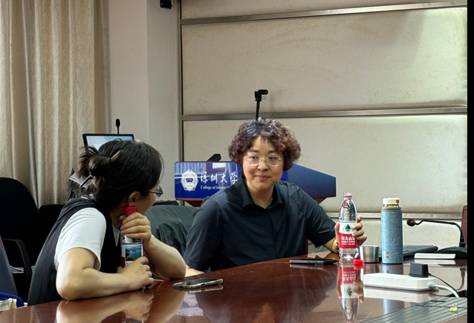
Ma Haolan then walked through how large language models are reshaping every stage of the publishing process, from topic selection and content editing to translation review and knowledge value-added services. In topic selection, she explained, conventional AI tools can do little more than analyze data, whereas large language models can read vast quantities of academic papers, news reports, and social media trends from around the world to generate in-depth analytical reports, precisely identifying gaps, hot topics, and potential collaborations within a given research field and offering forward-looking guidance for internationally oriented academic publishing. In content editing and translation, she cited the Commercial Press’s own large-language-model publishing and translation platform as an example, describing a human-machine collaborative workflow that moves from “original manuscript → machine translation → expert review → finalized translation.” Drawing on the Commercial Press's proprietary academic terminology database and a network of university experts, the platform delivers high-precision translation across more than a hundred specialized fields, including philosophy, history, and law, meeting the quality standards required for published translations, and substantially improving both the efficiency and professionalism of academic translation.
Through concrete case studies, Ma Haolan offered a vivid picture of how much AI can improve publishing efficiency. Take a 100,000-word classic work of linguistics as an example: with the assistance of large language models, the entire publishing workflow, including pre-processing, translation, and review by foreign experts, can be completed in just one and a half to two months. Meanwhile, drafting a 20,000-word English-language chapter summary takes AI only about half an hour, far more faster than the roughly five hours it would take a human translator, and it substantially cuts down the time needed for subsequent human polishing as well. In post-translation review, large language models applied to linguistic texts can quickly flag inconsistencies in terminology and expression, which are then corrected precisely by human experts, striking a balance between efficiency and quality.
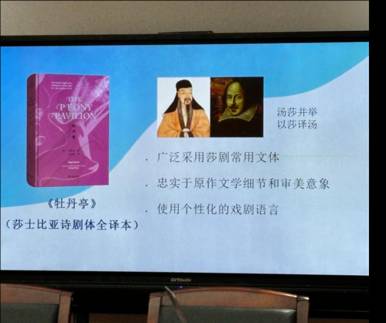
Turning to the practice of academic translation and the translation of Chinese classics into English, Ma Haolan focused on how large language models are helping Chinese culture “go global” in innovative ways. Citing Roger T. Ames’s translations of Confucian classics, she emphasized the role that large language models can play in dispelling cultural misreadings and rebuilding discursive frameworks across languages. She also discussed a Shakespearean verse-drama rendition of The Peony Pavilion, showing how large language models can assist in cross-cultural adaptation—remaining faithful to the literary detail and aesthetic imagery of the original while adopting styles and language familiar to target readers, thereby advancing the international circulation of Chinese classical texts.
In addition, Ma Haolan also pointed to new forms of value that large language models can bring to the publishing industry. By feeding the static content of traditional books into large language models, publishers can create interactive knowledge assistants, transforming what was once one-way publishing into dynamic, conversational knowledge services that greatly enhance the value and appeal of books. At the same time, AI is pushing academic publishing to evolve from simply “producing content” to “building platforms,” and from “one-way dissemination” to “two-way dialogue,” creating new models of knowledge service and allowing Chinese scholarship to engage in broader and deeper exchange on the international stage.
Toward the end of the lecture, Ma Haolan summed up by noting that large language models are more than just a technical tool, they are a strategic lever for helping Chinese academic publishing go global. By planning with an AI-driven mindset and using large-model technology to break through key bottlenecks, Chinese academic publishing is moving past traditional constraints and achieving leapfrog development on a global scale. At the same time, she reminded the faculty and students in attendance that even as technology empowers this process, publishers must hold the line on academic quality and keep human judgment firmly in place within human-machine collaboration, ensuring that Chinese scholarship can go abroad efficiently while still accurately conveying its cultural substance and academic value.
During the Q&A session, faculty and students in attendance eagerly shared their reflections on the lecture. Many remarked that Ma Haolan’s insightful presentation had given them a much deeper understanding of the changes reshaping the publishing industry in the age of artificial intelligence. Teachers in attendance also took the opportunity to raise practical questions they had encountered in their own academic publishing work, and Ma Haolan, drawing on her extensive experience as a publishing professional, offered them concrete advice. The lively and engaging exchange broadened the perspectives of everyone present and sparked new ideas. Attendees all expressed that they had gained a great deal from the lecture. The lecture concluded with warm and sustained applause.


