Editor's Note
Research Spotlight is a series from the College of International Studies (CIS) at Shenzhen University that introduces recent publications by our faculty, students, and alumni. Each feature explains what a study set out to investigate, how it was done, and what it found, in terms accessible to readers both inside and outside the field.
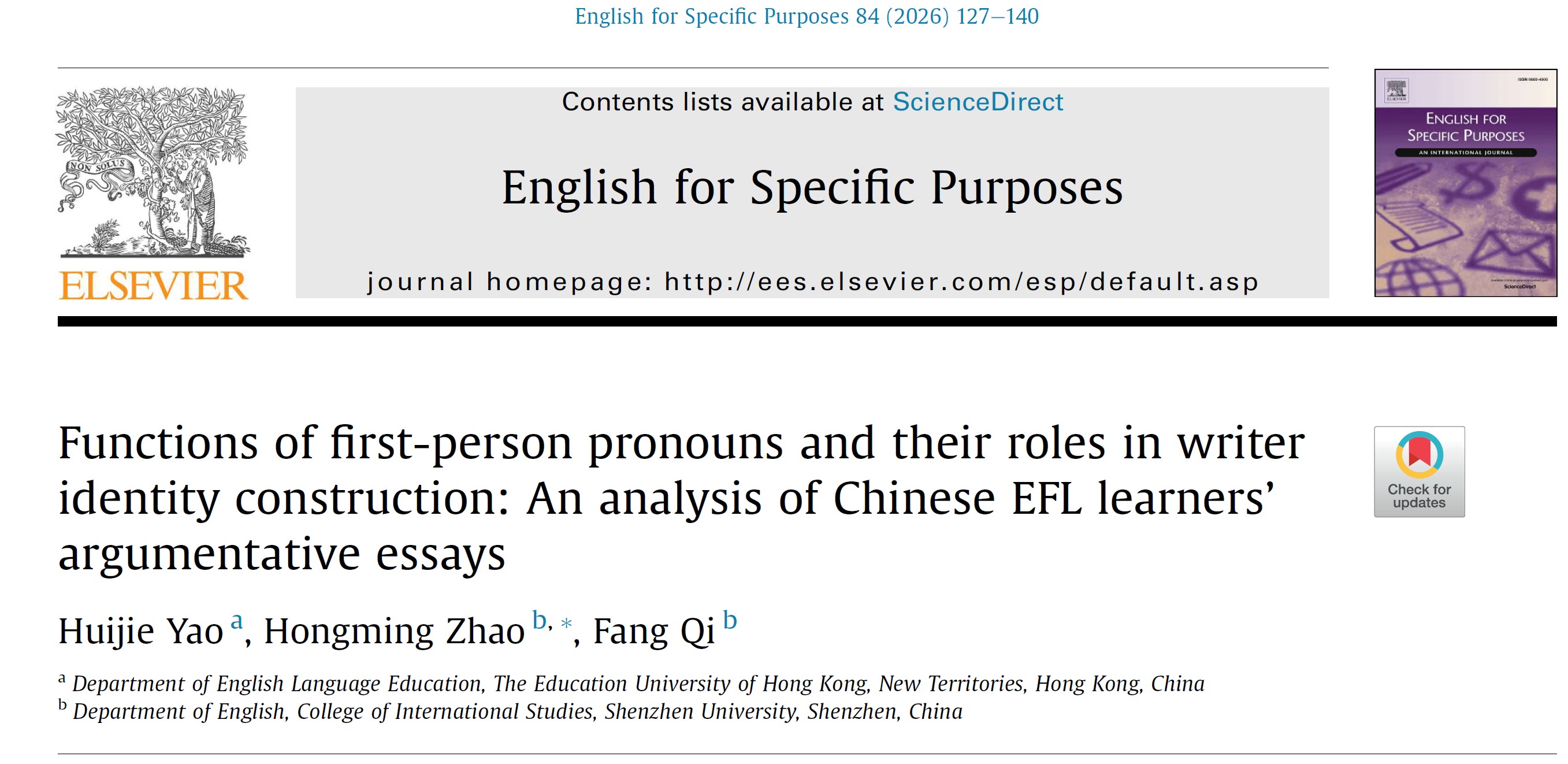
A new study co-authored by CIS alumnus Yao Huijie (English, Class of 2020), now a PhD student at The Education University of Hong Kong, together with Dr. Zhao Hongming and Associate Professor Qi Fang of the CIS English Department, has been published in English for Specific Purposes, an SSCI Q1 journal. The article, “Functions of first-person pronouns and their roles in writer identity construction: An analysis of Chinese EFL learners’ argumentative essays,” shows how Chinese university students use I and we to take positions, engage readers, and project distinct writer identities. The first page of the article is shown below.
About the Journal
Published by Elsevier, English for Specific Purposes is a leading international journal in the field of ESP research and teaching, covering areas such as English for academic purposes, English for occupational purposes, and intercultural academic communication. Known for its rigorous peer review and interdisciplinary scope, it is widely regarded as one of the flagship journals in the field. The journal is ranked in Q1 of the SSCI Linguistics category, with a CiteScore of 7.5 and an Impact Factor of 3.0.
Background
Over the past few decades, views of academic writing have shifted from an impersonal model toward a more interactive one. Traditional conventions, particularly in the sciences, encouraged writers to present knowledge objectively and avoid the first person, giving rise to the widespread belief that good academic writing should not use “I” or “we.” Later research, however, showed that academic discourse is inherently dialogic and social: writers do not simply transmit information but actively take positions and engage with readers through their rhetorical choices. From this perspective, first-person pronouns are not merely a matter of style but a key resource for establishing an authorial presence.
Yet research on interaction and research on writer identity have largely developed in parallel. Identity-oriented frameworks (e.g., Tang & John, 1999) say little about how writer roles are realized through interactional moves, while interaction-oriented studies rarely examine how these moves add up to a coherent writer identity. This gap is especially relevant for Chinese EFL learners writing argumentative essays, who must navigate tensions between English academic norms and Chinese writing traditions while simultaneously advancing an argument and building a credible authorial voice.
Methods
The researchers compiled a learner corpus of 300 argumentative essays (89,413 words) written by second-year English majors at a university in Shenzhen. All participants were enrolled in core courses of the English program. Using the Toulmin model of argumentation (Toulmin, 2003) as a framework, they wrote timed essays of about 300 words on four social issues under standardized conditions.
The analysis combined two frameworks: Tang and John’s (1999) typology of writer identity roles and Hyland’s (2005) model of stance and engagement. Coding proceeded in two stages. Instances of authorial identity were first coded deductively; the constant comparative method was then used to derive finer-grained interactional functions within each identity category and map them onto the stance–engagement framework. Two coders worked independently, reaching 78% initial agreement, with disagreements resolved through discussion. Chi-square tests of independence were also conducted to examine how the choice between singular (I/me/my) and plural (we/us/our) pronouns related to interactional functions and stance–engagement categories.
Key Findings
The study identified seven interactional functions of first-person pronouns and showed how they map systematically onto six writer identities. Four functions relate to stance: highlighting personal relevance (Narrator), stating a position (Opinion-holder), marking an epistemic contribution (Originator), and expressing evaluative judgment (Originator). Three relate to engagement: creating shared understanding (Interlocutor), appealing to common ground (Representative), and directing reader attention (Guide). By linking the abstract notion of writer identity to observable rhetorical moves, the framework makes identity construction easier to analyze and trace in texts.
Chi-square analysis revealed a very strong association between pronoun number and interactional function (χ² = 780.017, p < .001, Cramér’s V = 0.951). Singular pronouns were significantly overrepresented across all stance functions, whereas plural pronouns dominated the reader-oriented engagement functions of appealing to common ground and creating shared understanding. The authors interpret this pattern as reflecting both the rhetorical demands of argumentative writing and Chinese cultural orientations: students use I to take individual responsibility for their arguments and we to build solidarity with readers, consistent with a rhetorical tradition that values collective positioning and moderate self-assertion. Theoretically, the study bridges the long-standing divide between research on interaction and research on writer identity. Pedagogically, it offers L2 writing teachers a practical framework for helping students view pronoun choices in terms of rhetorical function and write with greater purpose and sensitivity to context.
Read the full article
About the Authors

Yao Huijie is a PhD student in the Department of English Language Education at The Education University of Hong Kong and a 2020 graduate of the CIS English program at Shenzhen University. Yao’s research interests include English for academic purposes, the psychology of language learning, and out-of-class language learning, with publications in System, Journal of Computer Assisted Learning, and Innovation in Language Learning and Teaching, among other journals.

Zhao Hongming is a Lecturer in the CIS English Department at Shenzhen University. He holds a PhD in Applied Linguistics from Guangdong University of Foreign Studies. His research focuses on psycholinguistics, bilingual language control, and the cognitive advantages of interpreters. His work has appeared in Journal of Neurolinguistics, Translation, Cognition & Behavior, and Advances in Psychological Science, among other journals.

Qi Fang is an Associate Professor in the CIS English Department at Shenzhen University, with more than 30 years of experience in cultural studies, linguistics, and English language teaching. Qi’s research interests include second language writing, contrastive rhetoric, sociolinguistics, and language contact from a translanguaging perspective, with publications in Asian Englishes, Foreign Language Teaching, China Foreign Languages, and Frontiers of Foreign Language Teaching, among other journals.
Text: Zhao Hongming


